The Future of Software: Could We See a 'Hand-Made' Label?
December 20, 2025
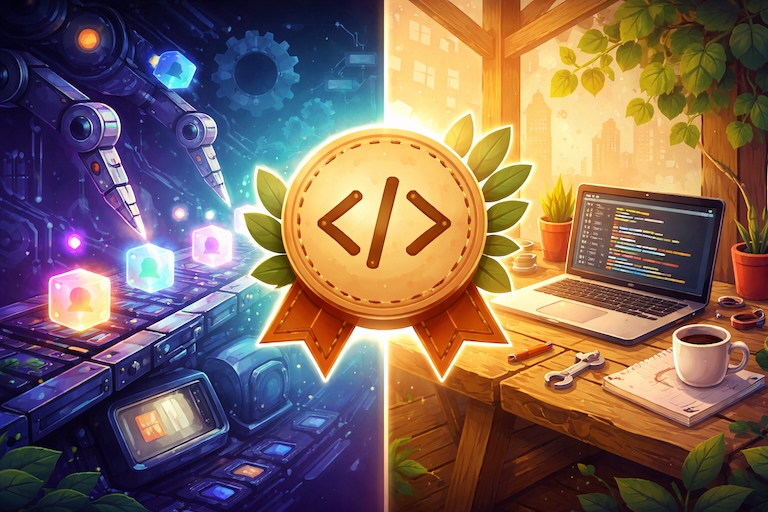
A simple look at how AI is changing software and why human-made code may one day become something rare and valuable, like handmade goods in a factory world.
Using AI to complete a task faster can save us time today. Building a system with AI can change whether we need to perform that task ourselves at all.
We are living through a major change in how work gets done. AI can now write, research, analyze data, create images, write code, and perform many other tasks that once required hours of human effort.
Most people are starting to use AI in a natural way. They add it to the work they already do. They use it to write an email faster. They ask it to summarize a document. They use it to analyze data or create a presentation.
This is useful, and it is often the right place to start. But when a new technology appears, we usually begin by using it to improve an old process. It takes longer to realize that the technology may allow us to redesign the whole process. That is where I believe the bigger opportunity with AI exists.
Using AI to complete a task faster can save us time today. Building a system with AI can change whether we need to perform that task ourselves at all.
Instead of only asking:
How can AI help me complete this task faster?
We should also ask:
Can I build a system that handles this work again and again?
This small change in thinking can have a much bigger effect.
Imagine that part of your job is to collect information from different sources. You review the information, organize it, find useful patterns, and prepare a report.
Without AI, this work might take several days. With an AI assistant, you might complete it in a few hours.
But you still need to collect the information. You still need to give instructions, review the results, move information between tools, and prepare the final report. You have made the process faster. But the process still depends on your time and attention.
Now imagine building a system that does this work regularly. It collects the right information. It organizes and analyzes it. It finds important changes. It updates the report. It asks for your attention only when human judgment is needed.
Such a system could run throughout the day and night. It could handle much more information than one person could review. It would still need maintenance, monitoring, and clear limits. But it would not need you to start and manage every step.
This does two important things.
First, it scales the work you already know how to do. A process that once depended on your personal capacity can now run more often and handle much more information.
Second, it gives you more time to think. You can use that time to understand harder problems, make better decisions, and build better solutions.
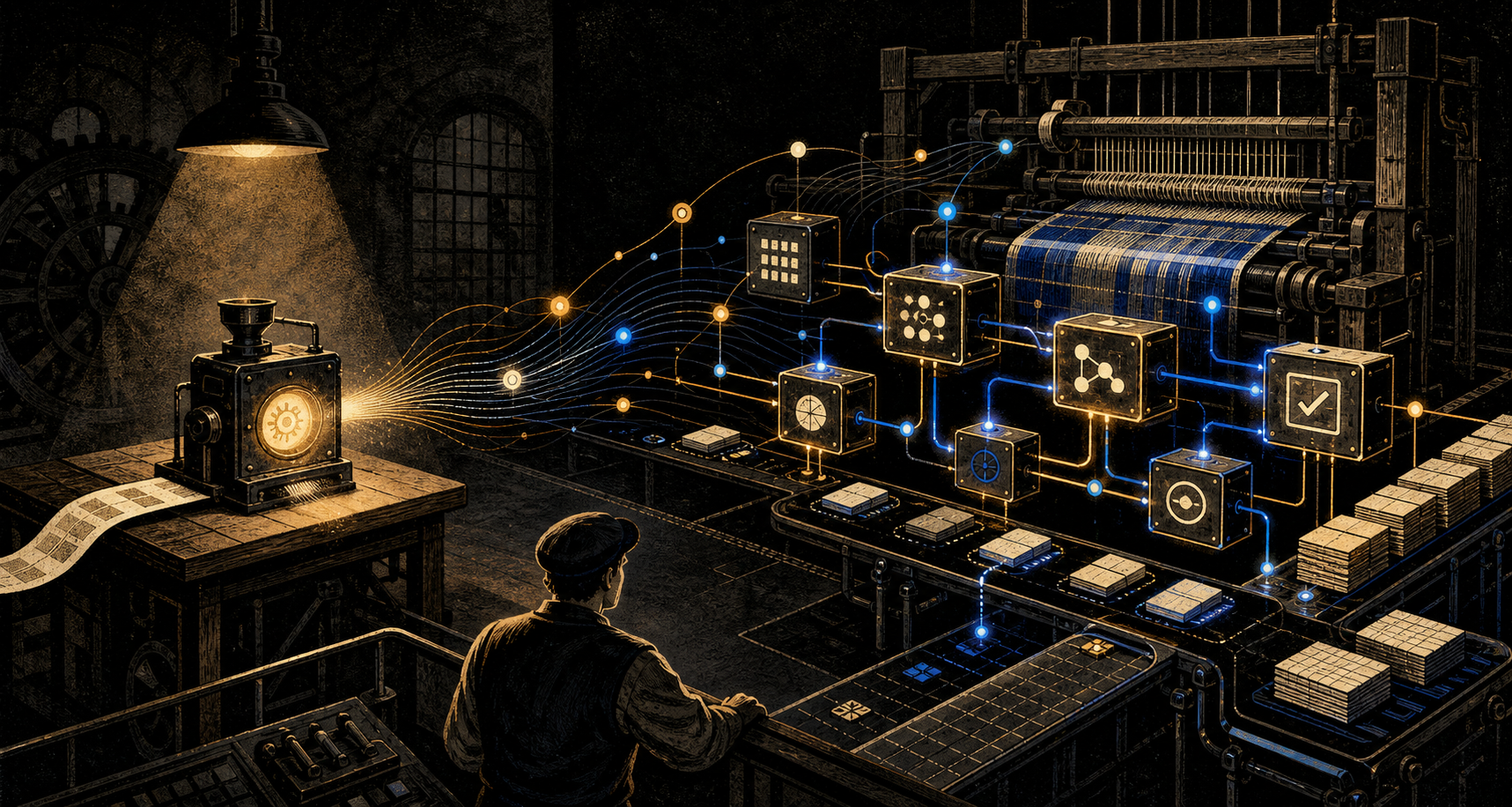
We can understand this change by looking at cloth production before and during industrialization. Before machines became common, producing cloth required manual work at almost every stage.
Cotton had to be picked and cleaned. Its fibers had to be prepared and spun into yarn. The yarn was then woven into cloth and finished. Much of the spinning and weaving happened inside homes or small workshops. This limited how much cloth a person or household could produce.
Then machines started helping with different parts of the process. Some machines made spinning faster. Other machines helped with weaving.
This is similar to how many of us use AI today. We bring AI into one part of our work. It helps us write, research, analyze, or organize information faster. But we still manage the whole process ourselves.
Textile production did not change all at once. Different parts were improved at different times. Home production and factory production continued together for many years.
Over time, more parts of textile production moved into powered mills and factories. Machines, workers, materials, and processes were organized into larger production systems. This allowed factories to produce cloth at a scale that individual workers could not reach on their own.
AI gives us a similar opportunity in knowledge work. Using AI for one task is like adding a machine to one part of cloth production. Building an AI system is like redesigning the full production process.
The difference is not only speed. A system creates a new ability. It can run while you sleep. It can repeat the same process many times. It can keep knowledge that once existed only inside someone’s head. It can also improve over time.
We can observe where it fails. We can improve its instructions and give it better tools. We can add checks, permissions, and approval steps. A process that once required constant human work may eventually need only occasional human supervision.
Industrialization did not create wealth simply because machines replaced human work. It created wealth because machines increased how much could be produced. A worker using a machine could produce much more than someone doing every step by hand.
Factories produced more goods in less time. Many goods became cheaper. Markets grew. New businesses and industries appeared.
This change was not smooth or fair. Many skilled workers lost their work or income. Factory conditions were often dangerous. Real wages did not rise immediately.
Over time, industrialization greatly increased productivity and national income. Average wages and living standards eventually rose, but the gains were not shared equally.
Industrialization became one of the main drivers of economic growth in Britain and other Western countries. It was not the only reason for that growth.
Trade, science, education, energy, infrastructure, strong institutions, and colonial systems also played important roles.
AI could create a similar rise in productivity for knowledge work. A person who builds useful AI systems may be able to produce much more than someone who completes every task by hand.
A small team may be able to do work that once needed a much larger organization. A business may be able to serve more customers, test more ideas, and operate for longer hours.
This creates the possibility of greater income and wealth. But it does not guarantee that every person will earn more. Greater effort does not always create greater income. Higher productivity creates more economic value, but ownership and bargaining power help decide who receives it.
Early AI systems will often be unreliable. They will misunderstand situations. They will produce inconsistent results. They will fail in unexpected ways.
Most current software was also designed for people to use directly. It was not designed for AI systems that can take actions on their own.
This is not a reason to avoid building. It is a reason to build carefully. We can add checks, permissions, logs, tests, approval steps, and clear ways to ask for human help.
The first version may handle only a small part of a process. The next version may complete common cases but ask for approval before taking action. Later versions may need human attention only when something unusual happens.
Reliable systems will not appear all at once. We will create them through testing, learning, and regular improvement.
We should also not assume that AI will automatically free everyone to do more interesting work. Industrialization created new jobs in machine operation, engineering, management, transport, research, education, and services.
But not every person who lost a job moved easily into better work. Some people benefited quickly. Others suffered for years. AI could follow a similar path.
Some companies may use AI to reduce their number of workers. Others may use it to demand more output from the same people.
People will need time and support to learn new skills. Businesses, governments, and other institutions will need to help society manage the change. The opportunity is real, but the result will depend on the choices we make.
AI systems can operate continuously and serve a very large number of people. This can give enormous power to those who own them. A small group of people or companies could become extremely rich and powerful. That level of control could become dangerous.
The benefits of higher productivity will not spread automatically. Questions about ownership, competition, job loss, taxes, access, and political power will become more important.
These questions deserve serious attention from economists, historians, policymakers, and people who understand human society better than I do.
My argument here is narrower. AI has the potential to increase productivity in a major way. To make use of that potential, we must think beyond using AI as an assistant for individual tasks. We must learn to build systems with it.
How we share the wealth and power created by those systems is a different but equally important discussion.
AI can already perform many tasks that once required hours of manual work. It can also suggest questions, find patterns, and produce new ideas.
But people experience problems directly. We feel frustration. We notice when a process is painful, confusing, or unfair. We understand why a problem matters to us and to the people around us.
We decide which outcomes are worth working toward. We also take responsibility for the results. This is where human curiosity and creativity remain important.
A person can notice a real problem. They can understand why it matters. They can use AI to explore possible solutions. They can then build a system that handles that problem again and again.
Once the system takes care of the known problem, the person has more time to work on the next one.
This creates a useful cycle:
The most useful question is no longer:
How can AI help me do my work faster?
A better question is:
What can I build so this work no longer needs my constant involvement?
The first question improves your personal productivity. The second creates leverage.
Using AI may help you finish today’s work sooner. Building with AI can create a system that continues working tomorrow, next week, and next year.
That is why thinking in terms of building matters. It allows us to scale what we already know how to do. It gives us more time to find important problems, imagine better possibilities, and create new solutions.
AI can then help us turn those solutions into systems that continue producing value without needing our attention at every step.
December 20, 2025
A simple look at how AI is changing software and why human-made code may one day become something rare and valuable, like handmade goods in a factory world.
November 18, 2025
Learn why treating AI as a train with rails, rather than an airplane, leads to better software development outcomes through structured guidelines and intentional planning.